Introduction
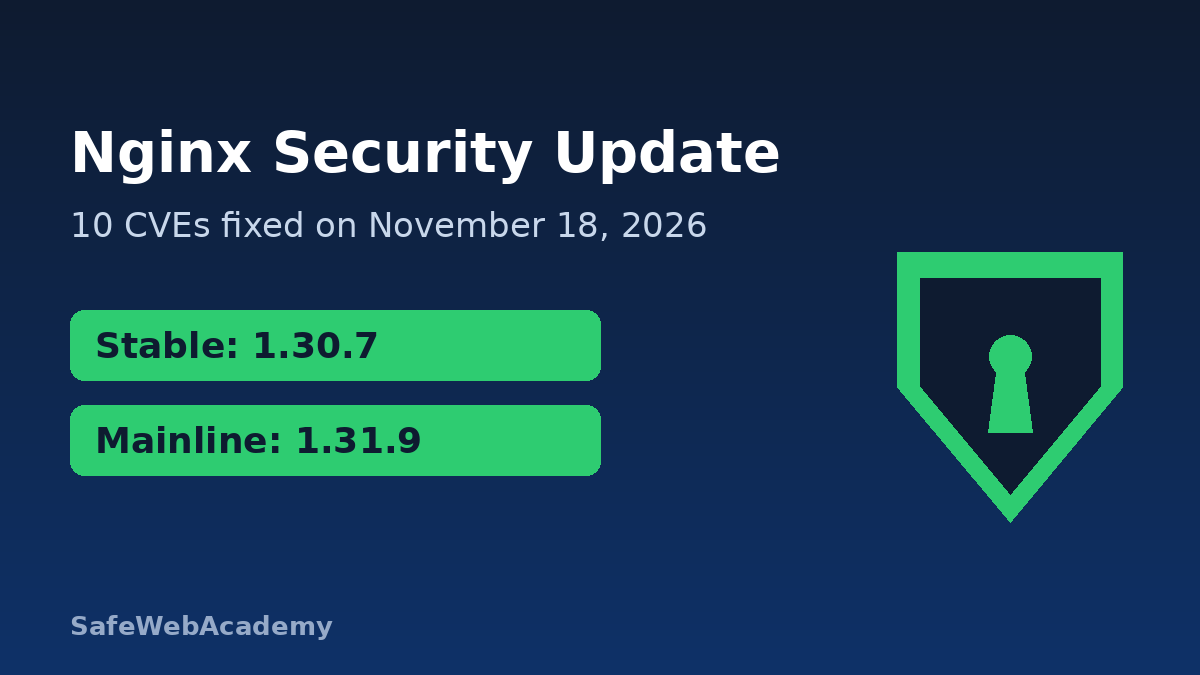
This nginx security update, released on November 18, 2026 as nginx 1.30.7 (stable) and 1.31.9 (mainline), fixes 10 vulnerabilities. Three are rated “major” by the nginx project, and F5 scores five of them 9.2 (critical) in CVSS v4.0. The affected features include HTTP/2, HTTP/3, the mail proxy, the resolver and several stream (TCP/TLS) modules.
Nginx fronts many PHP, Node.js and Python sites, so most admins should check their version this week. This article summarizes the official advisories and shows how to check and update, without exploit details.
Key Facts: Nginx Security Update at a Glance
- What: nginx 1.30.7 and 1.31.9 (released November 18, 2026) fix 10 CVEs.
- Most serious: CVE-2026-123007 (HTTP/2 flow control memory corruption), CVE-2026-118899 (infinite loop over TLS 1.3) and CVE-2026-113425 (mail proxy use-after-free), all rated “major” by nginx.org.
- Affected: nginx before 1.30.7 (stable) and 1.31.9 (mainline). Most issues go back many years, and the legacy 1.28 and older branches have no fixed release.
- Severity: five CVEs score 9.2 in CVSS v4.0 (8.1 in CVSS v3.1), as assigned by F5 as the CVE Numbering Authority.
- Exploitation: none reported. CISA’s SSVC assessment in NVD lists exploitation as “none” (November 18, 2026), and none of the CVEs is in the CISA KEV catalog (version 2026.11.18).
- Action: upgrade to nginx 1.30.7 or 1.31.9 (or your vendor’s patched package), then restart nginx.
Nginx Security Update Overview: What Does It Fix?
The nginx security update fixes memory-safety bugs, a denial-of-service loop and three validation bypasses. Severity comes from nginx.org; CVSS scores come from F5 as published in NVD.
| CVE | Issue | nginx.org severity | CVSS v4.0 / v3.1 (F5) | Vulnerable versions |
|---|---|---|---|---|
| CVE-2026-123007 | HTTP/2 flow control memory corruption | Major | 9.2 / 8.1 | 1.9.5 to 1.31.8 |
| CVE-2026-118899 | Infinite loop reading the request body over TLS 1.3 | Major | 8.7 / 7.5 | 1.13.0 to 1.31.8 |
| CVE-2026-113425 | Mail proxy use-after-free | Major | 9.2 / 8.1 | 0.5.33 to 1.31.8 |
| CVE-2026-123634 | Resolver use-after-free | Medium | 9.2 / 8.1 | 0.6.18 to 1.31.8 |
| CVE-2026-121810 | HTTP/3 use-after-free | Medium | 9.2 / 8.1 | 1.25.0 to 1.31.8 |
| CVE-2026-123633 | HTTP/2 use-after-free when proxying | Medium | 9.2 / 8.1 | 1.19.7 to 1.31.8 |
| CVE-2026-120967 | Stream SNI bypass of client certificate checks | Medium | 6.3 / 4.8 | 1.25.5 to 1.31.8 |
| CVE-2026-125283 | Buffer overflow with alias and try_files | Minor | 6.9 / 5.3 | 0.9.6 to 1.31.8 |
| CVE-2026-120993 | NULL pointer dereference with PROXY protocol v2 | Minor | 6.9 / 5.3 | 1.31.4 to 1.31.8 |
| CVE-2026-123640 | Insufficient validation in stream ssl_preread | Minor | 6.9 / 5.3 | 1.15.2 to 1.31.8 |
NVD has analyzed eight of these CVEs; CVE-2026-120993 and CVE-2026-120967 were still “Received” when we checked.
Which Nginx Versions Are Affected?
Every nginx release before 1.30.7 (stable) and 1.31.9 (mainline) is affected by at least one issue.
| Branch | Fixed in | Notes |
|---|---|---|
| 1.31 mainline | 1.31.9 | Fixes all 10 CVEs, including mainline-only CVE-2026-120993 |
| 1.30 stable | 1.30.7 | Fixes the 9 CVEs that affect the stable branch |
| 1.28 and older (legacy) | No fix | Inside the vulnerable ranges; upgrade to 1.30.7 or 1.31.9 |
According to the CPE data in NVD, F5’s NGINX Plus, NGINX Ingress Controller and NGINX Gateway Fabric are also affected. Check F5’s advisories if you run them.
What Is the Security Impact?
The worst case is a crashed nginx worker or, under extra conditions, code execution. Each issue only matters if you use the related feature.
What can the HTTP/2, HTTP/3 and resolver bugs do?
According to the F5 descriptions in NVD, CVE-2026-123007 can overflow the HTTP/2 flow control window and corrupt worker memory. CVE-2026-123633 affects HTTP/2 when nginx proxies requests and a worker runs low on worker_connections. CVE-2026-121810 is a similar use-after-free in HTTP/3. CVE-2026-123634 needs proxying with variables in the upstream name plus an SSI or mirror subrequest that resolves the same name.
For all four, F5 says a remote attacker can crash a worker. Code execution is possible on systems where ASLR is disabled or can be bypassed.
What about the denial-of-service and stream issues?
CVE-2026-118899 affects listen ... ssl servers with TLS 1.3. A crafted connection can trap a worker in an endless loop while it reads a request body, so the worker stops serving clients. CVE-2026-113425 only affects the mail proxy. The remaining issues are narrower:
- CVE-2026-120967: client certificate checks can be bypassed in a non-default stream server with
ssl_verify_client on. - CVE-2026-123640: a crafted ClientHello can forge
ssl_prereadvariables and change server selection. - CVE-2026-125283:
try_fileswithaliasand a map variable can crash a worker. - CVE-2026-120993: PROXY protocol v2 with dynamic certificate loading can crash a worker (mainline only).
How Do I Check Whether the Nginx Security Update Applies to Me?
Check your nginx version first, then look for the features named in the advisories.
How do I check my nginx version?
Run this on every server and inside every container image:
nginx -v
nginx -V 2>&1 | tr ' ' '\n' | grep -E "http_v2|http_v3|mail|stream"
Anything below 1.30.7 on the stable branch or below 1.31.9 on mainline is affected. Linux distributions often backport fixes without changing the version number, so also check your vendor’s security tracker.
How do I find the risky configuration?
Dump the full configuration and search for the features involved:
nginx -T 2>/dev/null | grep -nE "http2|quic|http3|mail|resolver|ssl_preread|ssl_verify_client|proxy_protocol|try_files|alias"If HTTP/2 or HTTP/3 is enabled on a public listener, treat this nginx security update as urgent. The same applies if you run nginx as a mail proxy.
How Do I Fix These Nginx Vulnerabilities?
Install nginx 1.30.7 or 1.31.9, or your vendor’s patched package, and restart nginx.
- Back up your configuration. Copy
/etc/nginxbefore updating. Our Ubuntu server backup guide covers the basics. - Upgrade. Use your package manager, the official nginx.org packages or a rebuilt container base image. Source tarballs are on the nginx download page.
- Test and restart. Run
nginx -t, then restart nginx so every worker runs the new binary. - Rebuild images that bundle nginx, and move off legacy 1.28 and older branches.
What if I cannot upgrade right away?
The nginx.org advisories list upgraded versions as the fix, and we found no official workaround. Until you can patch, general hardening reduces exposure: disable the mail proxy, HTTP/3 and stream features you do not use. This does not fix the HTTP/2 or TLS 1.3 issues, which only the upgrade does.
Are there behavior changes in 1.31.9?
Yes. Mainline 1.31.9 now rejects header lines without a colon and chunked request bodies with too much framing overhead. Test API clients and webhooks after upgrading. Stable 1.30.7 contains only the security fixes.
Additional Security Recommendations
Applying the nginx security update is the main defense. These habits also limit the damage from the next web server bug:
- Patch the whole stack. If nginx fronts PHP-FPM, also install the PHP security update for 8.5.13, 8.4.28, 8.3.37 and 8.2.36.
- Keep ASLR enabled. Several of these bugs need ASLR to be disabled or bypassed for code execution.
- Do not rely on a firewall alone. A web application firewall helps, but it does not replace patching.
- Harden the host. Our Ubuntu server hardening guide covers automatic security updates.
FAQ
Is the nginx security update urgent?
Yes, if you use HTTP/2, HTTP/3 or TLS 1.3, which most modern sites do. Five issues score 9.2 in CVSS v4.0, and CVE-2026-118899 can stop a worker with a crafted connection.
Are these nginx vulnerabilities being exploited?
No exploitation has been reported as of November 20, 2026. CISA’s SSVC entries list exploitation as “none,” and none of the CVEs is in the KEV catalog (version 2026.11.18). Public exploit availability is unknown.
Does this affect NGINX Plus or the Kubernetes ingress controller?
According to NVD, F5’s NGINX Plus, NGINX Ingress Controller and NGINX Gateway Fabric are affected by some of these CVEs. Check F5’s advisories for their fixed versions. The community ingress-nginx project is separate, and we did not verify its status.
Do I need to restart nginx after updating?
Yes. Restart nginx so every worker runs the fixed binary, and redeploy any containers that bundle nginx.
Conclusion
The nginx security update in versions 1.30.7 and 1.31.9 closes 10 vulnerabilities, including HTTP/2 memory corruption and a TLS 1.3 denial of service. Check your version, upgrade, restart nginx and rebuild container images. Then review any HTTP/3, mail or stream features you do not need.
References
All links below returned HTTP 200 when checked on November 20, 2026.
- nginx security advisories and nginx.org news (November 18, 2026)
- nginx 1.31.9 changes and nginx 1.30.7 changes
- nginx download page
- NVD: CVE-2026-123007, CVE-2026-118899, CVE-2026-113425, CVE-2026-123634, CVE-2026-121810
- NVD: CVE-2026-123633, CVE-2026-120967, CVE-2026-125283, CVE-2026-120993, CVE-2026-123640
- F5 advisory for CVE-2026-123007: K000163926 (other F5 K articles are linked from the nginx.org advisories page)
- CISA Known Exploited Vulnerabilities catalog
Related Articles
- PHP 8.5.13, 8.4.28, 8.3.37 and 8.2.36 Security Update: What to Patch Now
- Complete Guide to Web Application Firewall WAF
- How to Secure Your Ubuntu Server: A Beginner-Friendly Guide
- Zero Day Vulnerability Explained
- How to backup up Ubuntu server
- Apache HTTP Server 2.4.71: Patch mod_http2 CVE-2026-119618
Last Verified: November 20, 2026. Prepared by SafeWebAcademy from the official nginx.org advisories, nginx changelogs and NVD records linked above. This is not an official nginx or F5 publication. Security details can change, so check the linked advisories for updates.
Leave a Reply