Tag: Zero-day

  • What Is a CVE? CVE Meaning, Vulnerability Databases, Scoring and Triage

    What Is a CVE? CVE Meaning, Vulnerability Databases, Scoring and Triage

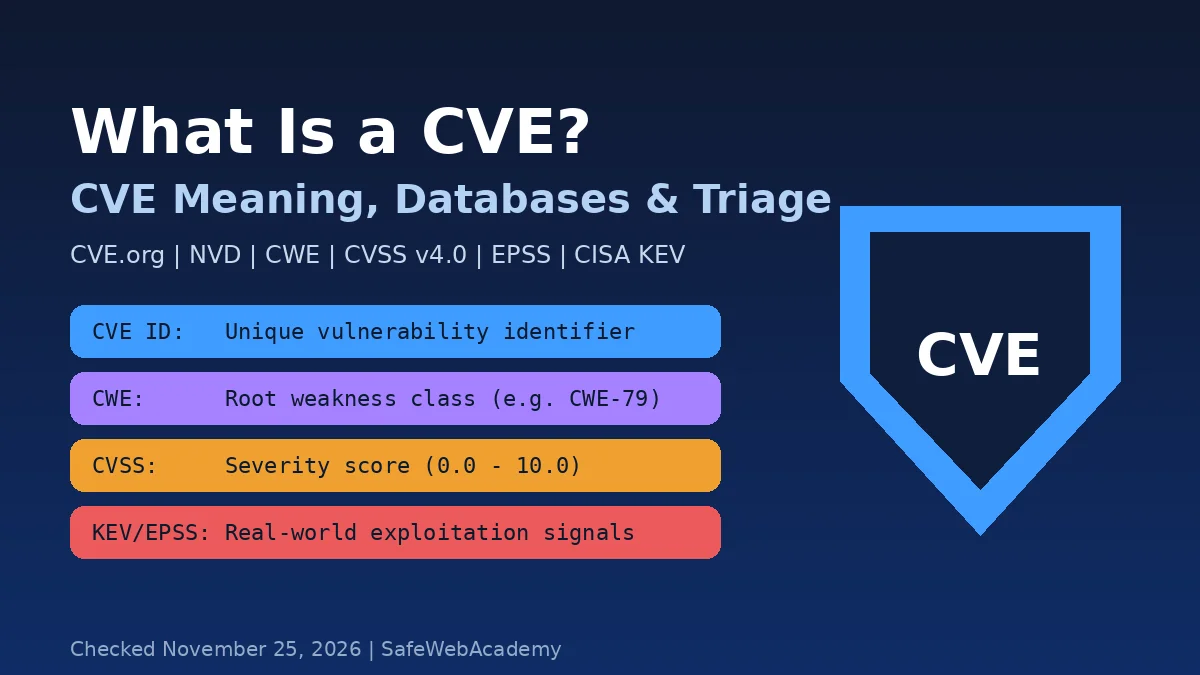
    What Is a CVE graphic: CVE ID, CWE weakness, CVSS severity, and KEV/EPSS exploitation signals beside a blue CVE shield

    Introduction

    When a vendor releases an urgent security patch, the advisory almost always centers on a code like CVE-2026-132165. Understanding CVE meaning—what that identifier represents, who issues it, and how it connects to severity scores and exploit catalogs—helps developers, system administrators, and security teams decide which updates require immediate patching and which belong in a regular maintenance window.

    CVE stands for Common Vulnerabilities and Exposures, an international catalog maintained by the CVE Program at cve.org. A CVE ID does not measure severity on its own; it provides one canonical label so vendors, scanners, and defenders know they are discussing the same publicly disclosed vulnerability. As of November 25, 2026, practical CVE security triage pairs the CVE Record with four companion resources: NVD (enrichment and product matching), CWE (root weakness category), CVSS (severity score), and CISA KEV / EPSS (real-world exploitation signals).

    Key Facts: CVE Meaning at a Glance

    • CVE stands for: Common Vulnerabilities and Exposures—one unique identifier per publicly disclosed cybersecurity vulnerability.
    • Format: CVE-YYYY-NNNN (four or more trailing digits, such as CVE-2026-132165), assigned by authorized CVE Numbering Authorities (CNAs).
    • Record lifecycle states: Reserved (assigned, details embargoed), Published (public record populated), and Rejected (withdrawn or duplicate, retained so teams stop tracking it).
    • What CVE does NOT score: The CVE Program itself does not calculate severity scores; CNAs, Authorized Data Publishers (ADPs), and NVD provide CVSS metrics and weakness mappings.
    • KEV vs. CVSS: A high CVSS score does not prove active exploitation, while any flaw listed in the CISA Known Exploited Vulnerabilities (KEV) catalog carries active threat urgency and BOD 26-04 deadlines.
    • Pending CVEs: Many open-source advisories publish first with a GitHub Security Advisory (GHSA) ID while a CVE assignment is still pending.

    CVE Meaning and How the CVE Program Works

    Before the CVE Program existed, two scanners or vendors often described the same flaw under completely different names and bug numbers. A CVE Identifier solves that coordination problem by assigning one standard ID to each independently fixable, publicly disclosed vulnerability.

    The program runs through a federated hierarchy:

    • CVE Numbering Authorities (CNAs): Software vendors, open-source foundations, CERTs, and bug-bounty coordinators authorized to assign CVE IDs and publish CVE Records within their product scope.
    • Roots and Top-Level Roots (TL-Roots): Organizations overseeing groups of CNAs, alongside a CNA of Last Resort (CNA-LR) for products not covered by another CNA.
    • Authorized Data Publishers (ADPs): Trusted organizations—such as CISA-ADP—that enrich published CVE Records with extra references, CWE tags, or risk context without altering the CNA’s core description.

    Every CVE Record moves through defined states on CVE.org:

    • Reserved: Allocated by a CNA before public disclosure (if referenced publicly while still unpopulated, CVE.org calls it Reserved but Public).
    • Published: Populated with affected versions, description, and references in the CVE List.
    • Rejected: Marked invalid or duplicate and kept visible with a rejection note.

    CVE vs. NVD vs. CWE vs. CVSS vs. KEV vs. EPSS

    Security bulletins often pack half a dozen acronyms into one summary. Each framework answers a distinct triage question:

    System / StandardMaintained ByPrimary Question It AnswersExample
    CVECVE Program (cve.org)Which specific vulnerability is this?CVE-2026-132165 (Drupal installer flaw)
    NVDNIST (nvd.nist.gov)What affected product identifiers (CPEs) and enriched metadata exist?NVD detail record with CPEs & status
    CWEMITRE / CWE CommunityWhat kind of coding or design weakness caused it?CWE-78 (OS Command Injection)
    CVSSFIRST (first.org)How severe is the worst-case technical impact (0.0–10.0)?CVSS v4.0 Base 9.3 Critical / v3.1 7.5 High
    CISA KEVCISA (cisa.gov)Is it actively exploited in the wild right now?KEV entry with BOD 26-04 due date
    EPSSFIRST (first.org)What is the probability of exploitation in the next 30 days?Daily 0–1 probability & percentile

    Watch two common NVD/CVSS pitfalls:

    1. “Awaiting Analysis” in NVD: A CVE can be Published on CVE.org before NIST finishes NVD enrichment. While in Awaiting Analysis, NVD shows N/A for its own assessment while still displaying CNA or ADP CVSS scores and CWEs. Never treat NVD: N/A as safe to ignore.
    2. CVSS v3.1 vs. CVSS v4.0: FIRST’s CVSS v4.0 refines attack requirements and downstream system impact, while many tools still report CVSS v3.1 alongside it. Both measure theoretical severity—not whether attackers are exploiting the flaw right now.
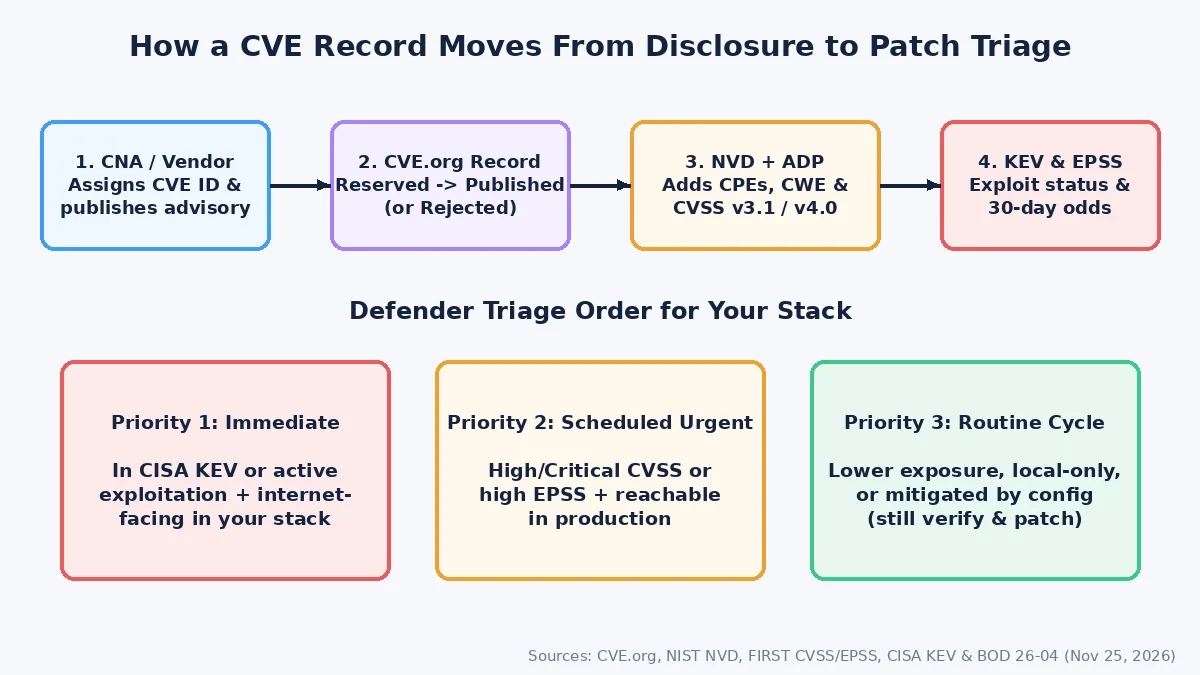
    CVE ecosystem and defender patch triage workflow from CNA assignment to CISA KEV and EPSS prioritization
    A vulnerability moves from CNA assignment through CVE.org, NVD/CWE/CVSS enrichment, and KEV/EPSS exploitation signals before team triage.

    How to Read a Real CVE Record Step by Step

    When inspecting a record in a CVE database (cve.org or nvd.nist.gov), check six fields before reacting to the headline score:

    1. Description and Trigger Conditions: Check how the bug triggers and what config it requires. For example, nginx CVE-2026-132779 spikes CPU only when ssl_early_data on is enabled, while Apache HTTP Server CVE-2026-119618 affects mod_http2. Configuration context tells you immediately if your hosts are exposed.
    2. Affected Versions and Fixed Branches: Confirm exact version ranges. In our Apache Tomcat November 2026 coverage, fixes shipped across multiple branches (11.0.x, 10.1.x, 9.0.x), while one cluster issue remained unfixed—requiring config mitigation rather than just an upgrade.
    3. CNA vs. NVD vs. ADP Fields: Vendor CNAs usually provide the sharpest version ranges; ADPs and NVD add CWE tags and CPE mappings.
    4. CWE Identifier: Common Weakness Enumeration IDs—such as CWE-79 (XSS), CWE-89 (SQL Injection), or CWE-502 (Deserialization of Untrusted Data)—reveal recurring root causes you can mitigate with safer APIs or a web application firewall.
    5. Exploitation Status (KEV & EPSS): Check CISA KEV first. On November 24, 2026, CISA added Drupal core CVE-2026-132165 to KEV with a November 27 due date under BOD 26-04 and required forensic triage. That signals active exploitation—patch and inspect logs immediately.
    6. Record Tags: Check for flags like disputed, unsupported-when-assigned (End-of-Life software), or exclusively-hosted-service.

    When an Advisory Has No CVE Yet

    Never ignore an advisory just because it lacks a CVE number. Open-source projects often disclose vulnerabilities via GitHub Security Advisories (GHSA-...) or release notes before a CVE is assigned. For example, the WordPress 7.1.5 security release fixed 20 core issues—led by an unauthenticated privilege escalation—under 19 GHSA IDs while CVE assignments were still pending. Likewise, PHP security updates routinely ship release bulletins ahead of full NVD enrichment. Follow vendor advisories directly alongside CVE feeds.

    How to Triage CVEs for Your Stack in Five Steps

    1. Match against exact inventory: Compare advisories to lockfiles (composer.lock, package-lock.json), container images, and OS packages—checking distro security trackers because Linux vendors often backport fixes without bumping upstream version numbers.
    2. Verify reachability: Confirm whether the vulnerable module is loaded and internet-facing. A zero-day vulnerability or unauthenticated remote bug on an exposed proxy beats a local-only flaw.
    3. Prioritize by KEV and EPSS before CVSS: Patch KEV-listed flaws immediately (running forensic checks if flagged), and use EPSS percentiles to catch bugs gaining exploit momentum.
    4. Patch—or apply a verified workaround: Upgrade to the fixed release; if maintenance windows delay patching, apply vendor workarounds (like disabling ssl_early_data or restricting installer routes) as temporary containment.
    5. Restart and verify: Reload php-fpm, nginx, or Tomcat and confirm the running process reports the patched version.

    FAQ

    What does CVE stand for, and what is the CVE meaning in security?

    CVE stands for Common Vulnerabilities and Exposures. In security operations, a CVE ID is a shared, unique identifier for a specific publicly disclosed vulnerability so teams and tools reference the exact same flaw.

    Does a higher CVSS score always mean higher priority?

    No. CVSS reflects worst-case technical severity, not active attacks. A CVSS 7.5 bug listed in CISA KEV is far more urgent for an exposed app than an unused-feature CVSS 9.8 flaw with no known exploits.

    What is the difference between a CVE and a CWE?

    A CVE identifies a specific vulnerability in a specific product (such as CVE-2026-132165 in Drupal Core). A CWE identifies the underlying software weakness class (such as CWE-79 for Cross-Site Scripting).

    Why does a published CVE show “Awaiting Analysis” in NVD?

    The CNA publishes the CVE Record on CVE.org first, while NIST’s NVD enrichment adds CPE product tags and NVD CVSS ratings later. Check the CNA’s score, CWE, and vendor advisory right away rather than waiting.

    Where is the official CVE database?

    Canonical CVE Records live at cve.org. NIST’s NVD mirrors and enriches them with CPEs and CVSS scores, while CISA’s KEV catalog tracks actively exploited CVEs.

    Conclusion

    Understanding CVE meaning turns noisy vulnerability alerts into clear engineering action. Use the CVE ID as your canonical key, check configuration prerequisites and CWE root causes, prioritize CISA KEV and EPSS ahead of raw CVSS scores, and monitor vendor and GHSA advisories directly so pending CVEs never slip past your patch cycle.

    References

    All references below were verified on November 25, 2026.

    Related Articles

    Last Verified: November 25, 2026. Prepared by SafeWebAcademy from CVE.org, NIST NVD, MITRE CWE, FIRST, and CISA documentation linked above. Vulnerability records, scores, and KEV status evolve continuously; recheck live advisories before closing tickets.
  • Oracle EBS Zero Day Exploit Puts Business Data at Risk

    Oracle EBS Zero Day Exploit Puts Business Data at Risk

    Oracle E-Business Suite zero-day vulnerability warning

    In 2025, attackers exploited a critical Oracle EBS zero-day in Oracle E-Business Suite to steal data from organizations, then, from late September, emailed executives to demand payment. The flaw, CVE-2025-61882, lets an attacker run code on an unpatched EBS server over the network without logging in. This article covers what is confirmed, who was affected, and what to do if you run Oracle EBS.

    What is CVE-2025-61882?

    CVE-2025-61882 is a vulnerability in the BI Publisher Integration component of Oracle Concurrent Processing, part of Oracle E-Business Suite. Oracle’s security alert says it can be exploited over HTTP without authentication and can lead to remote code execution.

    • Affected versions: Oracle E-Business Suite 12.2.3 to 12.2.14.
    • Severity: CVSS 3.1 base score 9.8 (critical): network attack, low complexity, no privileges and no user interaction needed.
    • Patch: Oracle released an emergency Security Alert on 4 October 2025. Oracle notes that the October 2023 Critical Patch Update is a prerequisite for the update.
    • Exploited in the wild: CISA added the flaw to its Known Exploited Vulnerabilities catalog on 6 October 2025 and lists it as used in ransomware campaigns.

    Timeline of the Oracle EBS attacks

    • From 9 August 2025: Google Threat Intelligence Group and Mandiant assess that attackers exploited what may be CVE-2025-61882 as a zero-day against EBS customers, weeks before a patch existed. They saw additional suspicious activity as early as 10 July 2025.
    • 29 September 2025: a large email campaign began. Attackers claiming links to the CL0P extortion brand emailed executives and said they had stolen data from their Oracle EBS systems. The emails were sent from compromised third-party accounts.
    • 2 October 2025: Oracle said attackers might have exploited vulnerabilities fixed in its July 2025 updates and told customers to apply the latest patches.
    • 4 October 2025: Oracle released the emergency patch for CVE-2025-61882 (revised on 6 October to clarify the indicators of compromise).
    • 11 October 2025: Oracle released another patch, for CVE-2025-61884, a separate EBS flaw in Oracle Configurator (Runtime UI). Oracle rates it 7.5 (high), it also needs no authentication, and CISA added it to the Known Exploited Vulnerabilities catalog on 20 October 2025.

    In its October 2025 report, Mandiant said it was unclear which exploit chains map to which CVE, so apply both patches.

    How the attacks worked

    The attack did not depend on phishing an employee. The EBS server itself was reachable and vulnerable, so attackers could run code on it directly. Mandiant found that the attackers’ tools ran mainly in memory and stored payloads inside the EBS database, in the template tables XDO_TEMPLATES_B and XDO_LOBS. In some cases the attackers stole a significant amount of data.

    The extortion emails came weeks after the break-ins. This pattern, a zero-day in a widely used business application followed by a large extortion campaign, matches earlier CL0P-linked campaigns against file-transfer products such as MOVEit.

    What Oracle EBS customers should do

    1. Install Oracle’s patches. Apply the 4 October 2025 Security Alert update (after the October 2023 Critical Patch Update, which it requires), then the 11 October 2025 patch for CVE-2025-61884, and keep up with each quarterly Critical Patch Update.
    2. Hunt for signs of compromise. Mandiant recommends checking XDO_TEMPLATES_B and XDO_LOBS for suspicious templates, especially template codes starting with TMP or DEF. Review web logs for requests to TemplatePreviewPG with those template codes, and for unusual requests to /OA_HTML/configurator/UiServlet and /OA_HTML/SyncServlet.
    3. Block unneeded outbound traffic. The attackers’ code needed to call out to the internet. Restricting outbound connections from EBS servers can disrupt the attack even if a server is compromised.
    4. Use Oracle’s indicators of compromise. Oracle published IP addresses, commands and file hashes in its alert. Search your logs for them.
    5. Investigate memory if you suspect a breach. Because the implants ran in memory, memory forensics on the EBS Java processes may find what disk scans miss.
    6. Keep EBS off the open internet where you can, and upgrade unsupported versions. Oracle only provides these patches for supported versions, and says earlier versions are likely affected too.

    What to do if you receive an extortion email

    Do not reply or pay. Check whether your EBS environment shows signs of compromise, involve your incident response team, and review the legal duties to notify regulators and affected people. See our guide on how organizations can handle data breaches and our ransomware and extortion prevention guide.

    Frequently asked questions

    Was CVE-2025-61882 a zero-day?

    Google Threat Intelligence Group assesses that attackers exploited what may be CVE-2025-61882 as a zero-day from at least 9 August 2025, weeks before Oracle released a patch. In October 2025 Mandiant also said it was unclear which exploit chain matches which CVE.

    Do I need to be logged in to be attacked?

    No. Oracle states that the vulnerability is remotely exploitable without authentication, so strong user passwords or multi-factor authentication for EBS users do not protect against it. Patching does.

    Which Oracle EBS versions are affected?

    Oracle lists versions 12.2.3 to 12.2.14. Older versions are likely affected too, but Oracle does not test them or issue patches for them, so upgrade to a supported release.

    Where can I find the official guidance?

    Use Oracle’s Security Alert for CVE-2025-61882, the Google Cloud Threat Intelligence report on the campaign, and CISA’s Known Exploited Vulnerabilities catalog.

    The Oracle EBS campaign is a reminder that business-critical systems are targets and that patch speed matters. Watch Oracle’s alerts, apply them promptly, and test whether your own environment shows signs of compromise.

    Related reading

  • Zero Day Vulnerability Explained

    Zero Day Vulnerability Explained

    Zero-day vulnerability timeline from discovery to patch

    A zero-day vulnerability is a software flaw that attackers can exploit before the vendor has released a fix. Because no patch exists, ordinary updating does not protect you. This guide explains what zero-days are, how they are used, real examples from recent years, and the steps that reduce your exposure.

    What is a zero-day vulnerability?

    A zero-day vulnerability is a security flaw in software or hardware that the vendor has not yet fixed. The name comes from the vendor having had zero days to prepare a patch once the flaw is being exploited. People use three related terms:

    • Zero-day vulnerability: the unpatched flaw itself.
    • Zero-day exploit: the code or technique that takes advantage of it.
    • Zero-day attack: the use of that exploit against a target.

    Once a patch is released, the flaw is no longer a zero-day. Attackers who exploit it after that point are using an n-day vulnerability, and they rely on organizations being slow to patch.

    How a zero-day attack unfolds

    1. Discovery. Someone finds a flaw. This may be a researcher, the vendor or a criminal group.
    2. Exploitation. If attackers get there first, they use the flaw quietly against chosen targets or at scale, often for stealing sensitive information.
    3. Detection. A victim, researcher or security vendor notices the activity and reports it.
    4. Patch. The vendor investigates and releases an update or workaround, and usually publishes an advisory and a CVE identifier.
    5. Patching by customers. Organizations apply the fix. Until they do, they remain exposed, and copies of the exploit often spread.

    Detection and patching are the steps defenders control, so faster detection and faster patching shrink the risk window.

    Real-world zero-day examples

    MOVEit Transfer (CVE-2023-34362). In 2023, a SQL injection flaw in Progress MOVEit Transfer let unauthenticated attackers reach the product’s database. NVD rates it 9.8 (critical), and CISA added it to the Known Exploited Vulnerabilities catalog on 2 June 2023. Google Threat Intelligence Group lists MOVEit among the file-transfer products hit by mass exploitation of zero-days in CL0P-linked data-theft extortion campaigns, where extortion attempts typically began several weeks after the theft.

    Oracle E-Business Suite (CVE-2025-61882). Google Threat Intelligence Group and Mandiant assess that attackers exploited what may be this flaw as a zero-day from at least 9 August 2025. Oracle released its emergency patch on 4 October 2025, roughly eight weeks later. In some cases attackers stole a significant amount of data before then. See our full write-up: Oracle EBS zero-day exploit.

    Both cases show the same pattern. The target is a widely used business application that holds sensitive data, and the attackers wait to start extortion until after the data is gone.

    How to reduce your exposure to zero-days

    You cannot prevent every zero-day, but you can make attacks harder and shorter.

    • Patch fast, starting with exploited flaws. CISA’s Known Exploited Vulnerabilities (KEV) catalog lists flaws that are being used in attacks. Treat anything on it, that you run, as urgent.
    • Shrink the attack surface. Do not expose admin panels and business systems to the internet unless you must. Remove software you do not use.
    • Limit outbound traffic from servers. Many attacks need the compromised server to call out to the attacker. Blocking unneeded outbound connections can break the chain, as Mandiant recommends for Oracle EBS.
    • Put a filter in front of web apps. A web application firewall can sometimes block exploit patterns before a patch is available.
    • Segment your network and use least privilege. If a server is compromised, attackers should not be able to move freely.
    • Monitor and log. Collect logs, alert on unusual behavior, and know what normal looks like for your critical systems.
    • Keep tested backups and an incident response plan. You need to recover if an attack succeeds. Our WordPress backup guide is a good starting point.
    • Follow vendor advisories. Subscribe to security alerts for the products you run so you hear about emergency patches the day they are released, and keep your team educated about new threats.

    Frequently asked questions

    What is the difference between a zero-day and an n-day?

    A zero-day is exploited before a patch exists. An n-day is a flaw that has a patch available but has not been applied by the victim.

    Can antivirus stop a zero-day?

    Sometimes. Signature-based tools only recognize known threats, but behavior-based detection and endpoint detection and response can catch suspicious activity from an unknown exploit. Layered defenses work best.

    Who finds zero-days?

    Security researchers, vendors, government agencies and criminal groups. Responsible researchers report flaws to the vendor, while criminals keep them secret or sell them.

    How long do attackers keep using a zero-day?

    It varies. In the Oracle EBS case, Google and Mandiant assess that exploitation began about eight weeks before the patch. Once a patch is released, exploit code often spreads, so apply updates quickly.

    You cannot patch a zero-day before a fix exists, but you can limit the damage: reduce your attack surface, patch quickly once a fix is released, and prepare to respond.

    Related reading