Introduction
When a vendor releases an urgent security patch, the advisory almost always centers on a code like CVE-2026-132165. Understanding CVE meaning—what that identifier represents, who issues it, and how it connects to severity scores and exploit catalogs—helps developers, system administrators, and security teams decide which updates require immediate patching and which belong in a regular maintenance window.
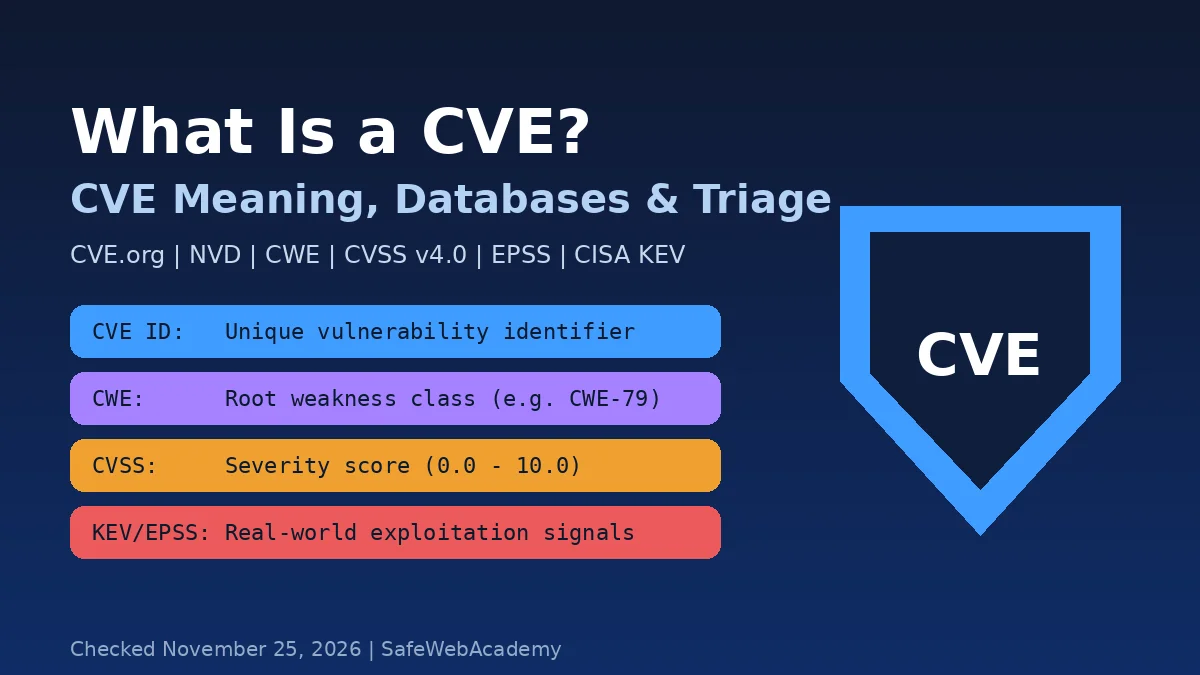
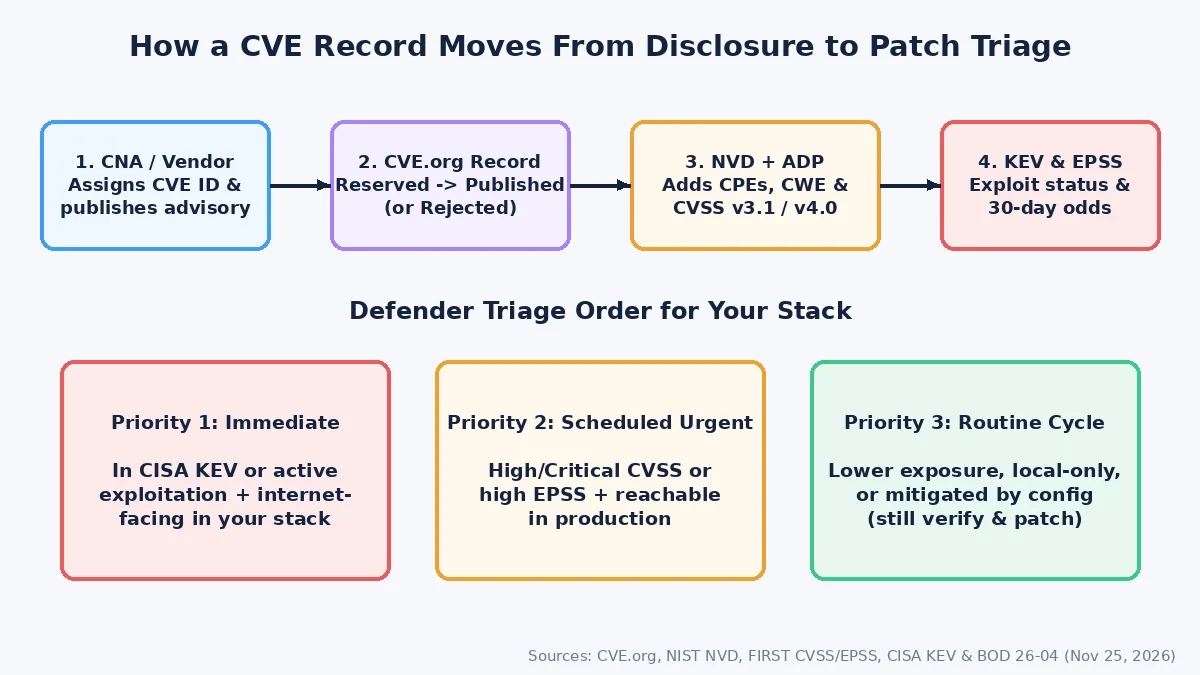
CVE stands for Common Vulnerabilities and Exposures, an international catalog maintained by the CVE Program at cve.org. A CVE ID does not measure severity on its own; it provides one canonical label so vendors, scanners, and defenders know they are discussing the same publicly disclosed vulnerability. As of November 25, 2026, practical CVE security triage pairs the CVE Record with four companion resources: NVD (enrichment and product matching), CWE (root weakness category), CVSS (severity score), and CISA KEV / EPSS (real-world exploitation signals).
Key Facts: CVE Meaning at a Glance
- CVE stands for: Common Vulnerabilities and Exposures—one unique identifier per publicly disclosed cybersecurity vulnerability.
- Format:
CVE-YYYY-NNNN(four or more trailing digits, such asCVE-2026-132165), assigned by authorized CVE Numbering Authorities (CNAs). - Record lifecycle states:
Reserved(assigned, details embargoed),Published(public record populated), andRejected(withdrawn or duplicate, retained so teams stop tracking it). - What CVE does NOT score: The CVE Program itself does not calculate severity scores; CNAs, Authorized Data Publishers (ADPs), and NVD provide CVSS metrics and weakness mappings.
- KEV vs. CVSS: A high CVSS score does not prove active exploitation, while any flaw listed in the CISA Known Exploited Vulnerabilities (KEV) catalog carries active threat urgency and BOD 26-04 deadlines.
- Pending CVEs: Many open-source advisories publish first with a GitHub Security Advisory (
GHSA) ID while a CVE assignment is still pending.
CVE Meaning and How the CVE Program Works
Before the CVE Program existed, two scanners or vendors often described the same flaw under completely different names and bug numbers. A CVE Identifier solves that coordination problem by assigning one standard ID to each independently fixable, publicly disclosed vulnerability.
The program runs through a federated hierarchy:
- CVE Numbering Authorities (CNAs): Software vendors, open-source foundations, CERTs, and bug-bounty coordinators authorized to assign CVE IDs and publish CVE Records within their product scope.
- Roots and Top-Level Roots (TL-Roots): Organizations overseeing groups of CNAs, alongside a CNA of Last Resort (CNA-LR) for products not covered by another CNA.
- Authorized Data Publishers (ADPs): Trusted organizations—such as CISA-ADP—that enrich published CVE Records with extra references, CWE tags, or risk context without altering the CNA’s core description.
Every CVE Record moves through defined states on CVE.org:
- Reserved: Allocated by a CNA before public disclosure (if referenced publicly while still unpopulated, CVE.org calls it Reserved but Public).
- Published: Populated with affected versions, description, and references in the CVE List.
- Rejected: Marked invalid or duplicate and kept visible with a rejection note.
CVE vs. NVD vs. CWE vs. CVSS vs. KEV vs. EPSS
Security bulletins often pack half a dozen acronyms into one summary. Each framework answers a distinct triage question:
| System / Standard | Maintained By | Primary Question It Answers | Example |
|---|---|---|---|
| CVE | CVE Program (cve.org) | Which specific vulnerability is this? | CVE-2026-132165 (Drupal installer flaw) |
| NVD | NIST (nvd.nist.gov) | What affected product identifiers (CPEs) and enriched metadata exist? | NVD detail record with CPEs & status |
| CWE | MITRE / CWE Community | What kind of coding or design weakness caused it? | CWE-78 (OS Command Injection) |
| CVSS | FIRST (first.org) | How severe is the worst-case technical impact (0.0–10.0)? | CVSS v4.0 Base 9.3 Critical / v3.1 7.5 High |
| CISA KEV | CISA (cisa.gov) | Is it actively exploited in the wild right now? | KEV entry with BOD 26-04 due date |
| EPSS | FIRST (first.org) | What is the probability of exploitation in the next 30 days? | Daily 0–1 probability & percentile |
Watch two common NVD/CVSS pitfalls:
- “Awaiting Analysis” in NVD: A CVE can be
Publishedon CVE.org before NIST finishes NVD enrichment. While in Awaiting Analysis, NVD showsN/Afor its own assessment while still displaying CNA or ADP CVSS scores and CWEs. Never treatNVD: N/Aas safe to ignore. - CVSS v3.1 vs. CVSS v4.0: FIRST’s CVSS v4.0 refines attack requirements and downstream system impact, while many tools still report CVSS v3.1 alongside it. Both measure theoretical severity—not whether attackers are exploiting the flaw right now.
How to Read a Real CVE Record Step by Step
When inspecting a record in a CVE database (cve.org or nvd.nist.gov), check six fields before reacting to the headline score:
- Description and Trigger Conditions: Check how the bug triggers and what config it requires. For example, nginx CVE-2026-132779 spikes CPU only when
ssl_early_data onis enabled, while Apache HTTP Server CVE-2026-119618 affectsmod_http2. Configuration context tells you immediately if your hosts are exposed. - Affected Versions and Fixed Branches: Confirm exact version ranges. In our Apache Tomcat November 2026 coverage, fixes shipped across multiple branches (
11.0.x,10.1.x,9.0.x), while one cluster issue remained unfixed—requiring config mitigation rather than just an upgrade. - CNA vs. NVD vs. ADP Fields: Vendor CNAs usually provide the sharpest version ranges; ADPs and NVD add CWE tags and CPE mappings.
- CWE Identifier: Common Weakness Enumeration IDs—such as
CWE-79(XSS),CWE-89(SQL Injection), orCWE-502(Deserialization of Untrusted Data)—reveal recurring root causes you can mitigate with safer APIs or a web application firewall. - Exploitation Status (KEV & EPSS): Check CISA KEV first. On November 24, 2026, CISA added Drupal core CVE-2026-132165 to KEV with a November 27 due date under BOD 26-04 and required forensic triage. That signals active exploitation—patch and inspect logs immediately.
- Record Tags: Check for flags like
disputed,unsupported-when-assigned(End-of-Life software), orexclusively-hosted-service.
When an Advisory Has No CVE Yet
Never ignore an advisory just because it lacks a CVE number. Open-source projects often disclose vulnerabilities via GitHub Security Advisories (GHSA-...) or release notes before a CVE is assigned. For example, the WordPress 7.1.5 security release fixed 20 core issues—led by an unauthenticated privilege escalation—under 19 GHSA IDs while CVE assignments were still pending. Likewise, PHP security updates routinely ship release bulletins ahead of full NVD enrichment. Follow vendor advisories directly alongside CVE feeds.
How to Triage CVEs for Your Stack in Five Steps
- Match against exact inventory: Compare advisories to lockfiles (
composer.lock,package-lock.json), container images, and OS packages—checking distro security trackers because Linux vendors often backport fixes without bumping upstream version numbers. - Verify reachability: Confirm whether the vulnerable module is loaded and internet-facing. A zero-day vulnerability or unauthenticated remote bug on an exposed proxy beats a local-only flaw.
- Prioritize by KEV and EPSS before CVSS: Patch KEV-listed flaws immediately (running forensic checks if flagged), and use EPSS percentiles to catch bugs gaining exploit momentum.
- Patch—or apply a verified workaround: Upgrade to the fixed release; if maintenance windows delay patching, apply vendor workarounds (like disabling
ssl_early_dataor restricting installer routes) as temporary containment. - Restart and verify: Reload
php-fpm,nginx, or Tomcat and confirm the running process reports the patched version.
FAQ
What does CVE stand for, and what is the CVE meaning in security?
CVE stands for Common Vulnerabilities and Exposures. In security operations, a CVE ID is a shared, unique identifier for a specific publicly disclosed vulnerability so teams and tools reference the exact same flaw.
Does a higher CVSS score always mean higher priority?
No. CVSS reflects worst-case technical severity, not active attacks. A CVSS 7.5 bug listed in CISA KEV is far more urgent for an exposed app than an unused-feature CVSS 9.8 flaw with no known exploits.
What is the difference between a CVE and a CWE?
A CVE identifies a specific vulnerability in a specific product (such as CVE-2026-132165 in Drupal Core). A CWE identifies the underlying software weakness class (such as CWE-79 for Cross-Site Scripting).
Why does a published CVE show “Awaiting Analysis” in NVD?
The CNA publishes the CVE Record on CVE.org first, while NIST’s NVD enrichment adds CPE product tags and NVD CVSS ratings later. Check the CNA’s score, CWE, and vendor advisory right away rather than waiting.
Where is the official CVE database?
Canonical CVE Records live at cve.org. NIST’s NVD mirrors and enriches them with CPEs and CVSS scores, while CISA’s KEV catalog tracks actively exploited CVEs.
Conclusion
Understanding CVE meaning turns noisy vulnerability alerts into clear engineering action. Use the CVE ID as your canonical key, check configuration prerequisites and CWE root causes, prioritize CISA KEV and EPSS ahead of raw CVSS scores, and monitor vendor and GHSA advisories directly so pending CVEs never slip past your patch cycle.
References
All references below were verified on November 25, 2026.
- CVE Program: Overview
- CVE Program: Official Glossary (Record States, CNAs, ADPs)
- NIST National Vulnerability Database (NVD)
- MITRE Common Weakness Enumeration (CWE): About CWE
- FIRST: Common Vulnerability Scoring System (CVSS v4.0)
- FIRST: Exploit Prediction Scoring System (EPSS)
- CISA Known Exploited Vulnerabilities (KEV) Catalog
- CISA Binding Operational Directive (BOD) 26-04
Related Articles
- Zero Day Vulnerability Explained
- Drupal Security Update: Patch the Installer RCE (CVE-2026-132165) Now
- Nginx CVE-2026-132779: ssl_early_data CPU Flaw Fixed in 1.30.8 and 1.31.10
- Apache Tomcat Security Update: 10 CVEs Fixed and a Critical Cluster Flaw Still Pending
- Apache HTTP Server 2.4.71: Patch mod_http2 CVE-2026-119618
- WordPress 7.1.5 Security Release: What It Fixes and How to Update
- PHP 8.5.13, 8.4.28, 8.3.37 and 8.2.36 Security Update: What to Patch Now
Last Verified: November 25, 2026. Prepared by SafeWebAcademy from CVE.org, NIST NVD, MITRE CWE, FIRST, and CISA documentation linked above. Vulnerability records, scores, and KEV status evolve continuously; recheck live advisories before closing tickets.
Leave a Reply