Introduction
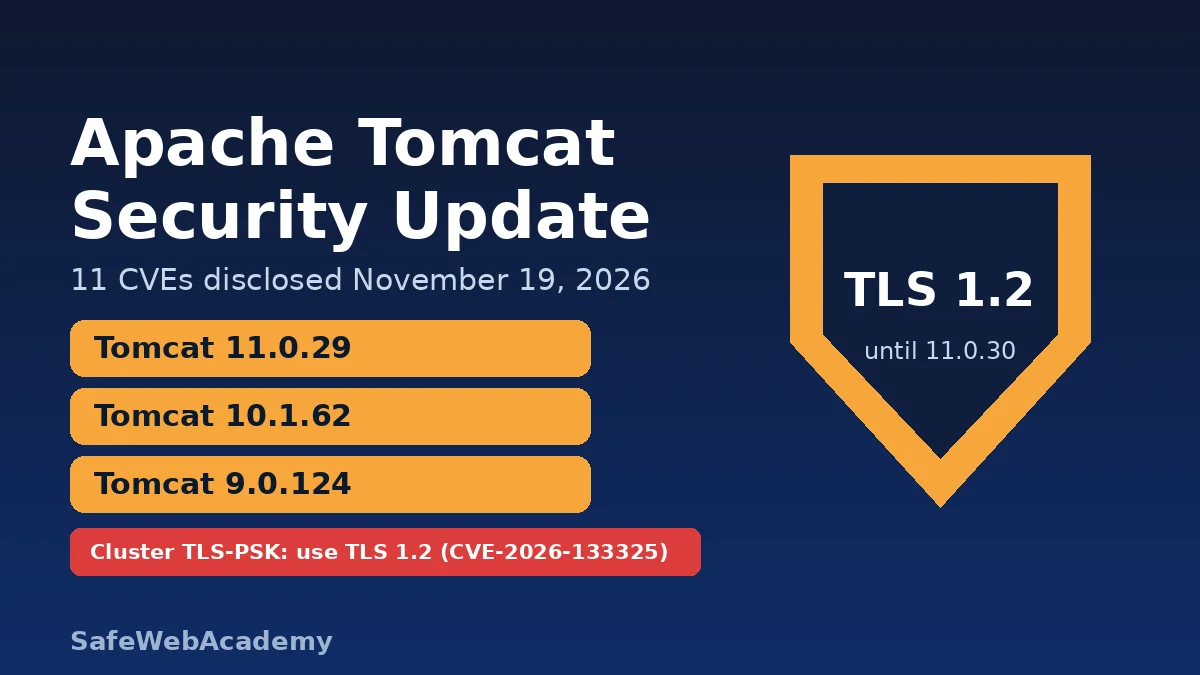
The latest Apache Tomcat security update matters to every team that runs Java web applications. On November 19, 2026, the Apache Tomcat project disclosed 11 CVEs. Ten of them are addressed in Tomcat 11.0.29, 10.1.62 and 9.0.124, released on November 13 and 16. The eleventh, CVE-2026-133325, is rated Critical and affects exactly those new releases when a cluster uses TLS 1.3 with a pre-shared key (TLS-PSK). Its fix is not released yet.
This article explains which versions are affected, which fixes apply to you and what to do now. It contains no exploit details.
Key Facts: Apache Tomcat Security Update at a Glance
- What: 11 Tomcat CVEs made public on November 19, 2026 (Apache ratings: 1 Critical, 4 Important, 2 Moderate, 4 Low).
- Fixed releases: Tomcat 11.0.29 (Nov 13), 10.1.62 (Nov 16) and 9.0.124 (Nov 13) address 10 CVEs. Tomcat 11.0.28 was never released.
- Critical issue: CVE-2026-133325 lets an unauthenticated node join a Tomcat cluster secured with TLS 1.3 and TLS-PSK. It affects 11.0.28 to 11.0.29, 10.1.62 and 9.0.124 only.
- Pending fix: 11.0.30, 10.1.63 and 9.0.125 will fix CVE-2026-133325 but were “not yet released” as of November 22, 2026. Apache’s workaround is to switch cluster encryption to TLS 1.2.
- Scores: CVSS v3.1 scores come from CISA-ADP on NVD (up to 9.8). NVD has not analyzed the records yet.
- Exploitation: none known. CISA’s SSVC data on NVD says “none” for the 10 CVEs it rated, and no Tomcat CVE is in the CISA KEV catalog (version 2026.11.20).
- Action: upgrade to 11.0.29, 10.1.62 or 9.0.124. If you use cluster TLS-PSK, also set TLS 1.2 until the next release.
What Does the Apache Tomcat Security Update Fix?
It fixes request-handling, denial-of-service (DoS) and authorization bugs in core Tomcat components. The table lists all 11 CVEs with Apache’s own severity rating.
| CVE | Issue (Apache’s description) | Apache rating | CISA-ADP CVSS |
|---|---|---|---|
| CVE-2026-133325 | Cluster TLS-PSK with TLS 1.3 does not validate the peer | Critical | 9.8 |
| CVE-2026-118028 | RewriteValve [F]/[G]/[R] rule matches do not stop processing | Important | 9.1 |
| CVE-2026-121649 | ExpiresFilter removes an existing Cache-Control: private header | Important | none yet |
| CVE-2026-116830 | HTTP/2 checks frame type before size, leading to DoS | Important | 7.5 |
| CVE-2026-116600 | Memory leak with OWB (OpenWebBeans) WebSocket integration, leading to DoS | Important | 7.5 |
| CVE-2026-95517 | Multiple weaknesses in the EncryptInterceptor (cluster) | Moderate | 9.1 |
| CVE-2026-118436 | CGIServlet drops a chunked POST body and can hang a worker thread | Moderate | 7.5 |
| CVE-2026-116561 | Jakarta Authentication secureResponse AuthException sends an unprotected HTTP 200 | Low | 9.1 |
| CVE-2026-106012 | Incorrect security-role-ref handling with RequestDispatcher.forward() | Low | 7.3 |
| CVE-2026-117517 | Incomplete fix for CVE-2026-25854 | Low | 7.3 |
| CVE-2026-118233 | Memory leak on HTTP upgrade, leading to DoS | Low | 7.5 |
The CISA-ADP scores are generic worst-case scores. Apache’s ratings consider how Tomcat is usually deployed, so use them first when you prioritize.
Which Apache Tomcat Versions Are Affected?
Every supported branch before the November releases is affected, and the November releases are affected by the cluster flaw.
| Branch | Affected by the 10 CVEs | Fixed in | Affected by CVE-2026-133325 | Fix for CVE-2026-133325 |
|---|---|---|---|---|
| 11.0.x | 11.0.0-M1 to 11.0.27 (some CVEs start later) | 11.0.29 | 11.0.28 to 11.0.29 | 11.0.30 (not yet released) |
| 10.1.x | 10.1.0-M1 to 10.1.61 (some CVEs start later) | 10.1.62 | 10.1.62 | 10.1.63 (not yet released) |
| 9.0.x | 9.0.0.M1 to 9.0.123 (some CVEs start later) | 9.0.124 | 9.0.124 | 9.0.125 (not yet released) |
| 8.5.x and older | Several CVEs, per NVD | No fix (end of life) | Not listed | Upgrade |
Exact starting versions differ per CVE. For example, CVE-2026-118028 starts at 11.0.0-M18, 10.1.20 and 9.0.87. Check the Tomcat security pages for each range.
What Is the Security Impact?
The impact depends on which Tomcat features you use, because most bugs sit in optional components.
Who is affected by the critical cluster flaw?
Only Tomcat clusters that use the built-in TLS with a pre-shared key are affected. In that setup, an unauthenticated node could join the cluster when it used TLS 1.3. Cluster members exchange replicated session data, so an unauthorized member is a serious risk. Single-server Tomcat installs and clusters without TLS-PSK are not affected by CVE-2026-133325.
Which other issues matter most?
- RewriteValve (CVE-2026-118028): rules with the [F], [G] or [R] flags did not stop processing. Apps that use rewrite rules to block or redirect requests should treat this as urgent.
- ExpiresFilter (CVE-2026-121649): the filter could remove
Cache-Control: privateset by authentication. Caches could then store private responses. - DoS bugs (CVE-2026-116830, -116600, -118233, -118436): these affect HTTP/2, WebSocket with OWB, HTTP upgrade and the CGI Servlet.
- EncryptInterceptor (CVE-2026-95517): Apache did not fix this component. It deprecated it and recommends TLS-PSK instead.
How Do I Check Whether I Am Affected?
Find your exact Tomcat version, then check which affected features you use.
How do I check my Tomcat version?
For a standalone install, run the version script from the Tomcat directory:
$CATALINA_HOME/bin/version.shOn Windows, run bin\version.bat. For applications that embed Tomcat, such as Spring Boot apps, check the tomcat-embed-core library version:
mvn dependency:tree -Dincludes=org.apache.tomcat.embedLinux distribution packages may carry backported fixes, so check your distribution’s security notice too.
How do I find cluster TLS-PSK and other risky settings?
Search server.xml for cluster, rewrite and filter settings:
grep -nE "<Cluster|pskKey|pskProtocol|EncryptInterceptor|RewriteValve|Http2Protocol" $CATALINA_BASE/conf/server.xml
grep -rn "ExpiresFilter\|CGIServlet" $CATALINA_BASE/conf/web.xml $CATALINA_BASE/webapps/*/WEB-INF/web.xml
A Channel with pskKey and pskIdentity means cluster TLS-PSK is enabled. If pskProtocol is missing, the default is TLSv1.3.
How Do I Fix the Apache Tomcat Vulnerabilities?
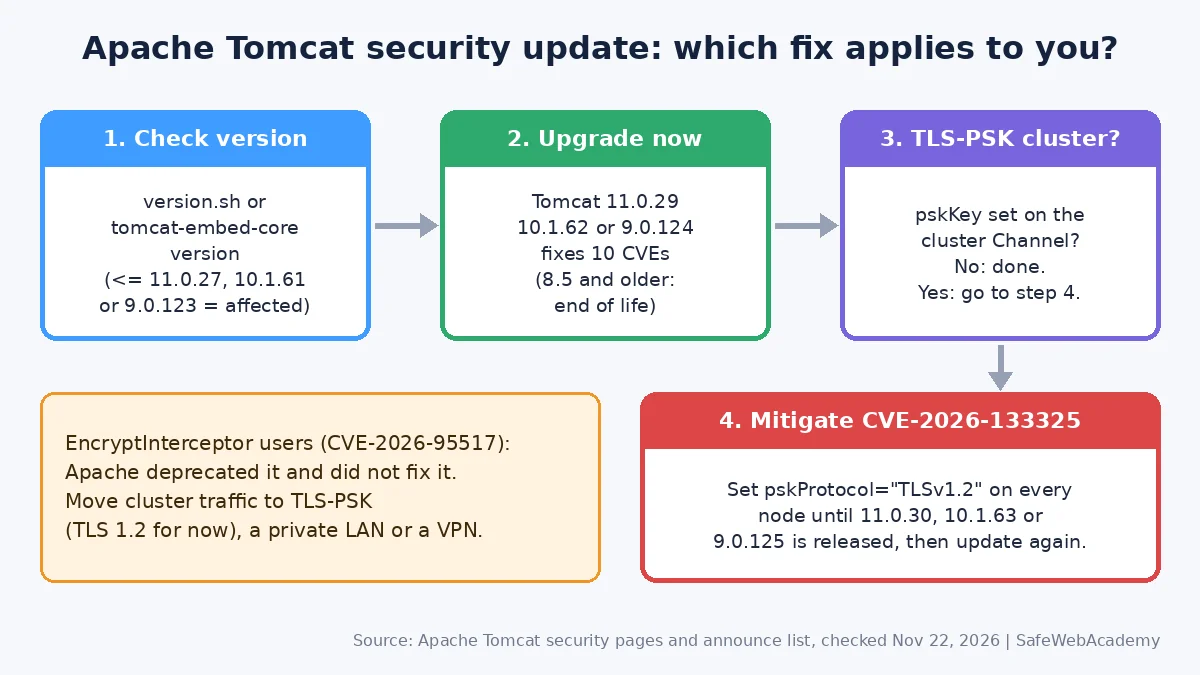
Upgrade first, then apply the TLS 1.2 workaround if you run a TLS-PSK cluster.
- Upgrade Tomcat. Move to 11.0.29, 10.1.62 or 9.0.124 from the official download page. Verify the signature or SHA-512 checksum.
- Update embedded Tomcat. Raise the
tomcat-embed-coreversion in your build, rebuild and redeploy every service and container image. - Protect TLS-PSK clusters. Following Apache’s mitigation, set
pskProtocol="TLSv1.2"on the clusterChannelon every node. Then restart the nodes. - Replace the EncryptInterceptor. Move cluster encryption to TLS-PSK, using TLS 1.2 for now, or use a private network or VPN.
- Plan the next update. Install 11.0.30, 10.1.63 or 9.0.125 when they are released, then revisit the TLS 1.2 setting.
- Leave end-of-life branches. Tomcat 8.5 and older get no fixes. Upgrade to a supported branch.
Additional Security Recommendations
An Apache Tomcat security update fixes code, but a few habits reduce the next risk:
- Keep cluster traffic private. Apache says clustering is “typically used over a secure, trusted network.” Do not expose cluster ports to the internet.
- Disable unused features. If you do not need the CGI Servlet, HTTP/2 or rewrite rules, do not enable them.
- Patch the front end too. Tomcat often runs behind nginx or Apache HTTP Server, which had their own November security releases.
- Add a filtering layer. A web application firewall can reduce exposure, but it does not replace patching.
FAQ
Is the Apache Tomcat security update urgent?
Yes for most teams. The update addresses 10 CVEs, including four rated Important. Teams using rewrite rules, ExpiresFilter or HTTP/2 should prioritize it.
Does upgrading to Tomcat 11.0.29 make the cluster flaw worse?
Only for clusters that use TLS-PSK with TLS 1.3. CVE-2026-133325 affects 11.0.28 to 11.0.29, 10.1.62 and 9.0.124. Upgrade anyway, and set pskProtocol="TLSv1.2" on such clusters.
Is Apache Tomcat being exploited?
There are no reports of exploitation. CISA’s SSVC entries on NVD say “none” for the 10 CVEs it rated, and no Tomcat CVE is in the CISA KEV catalog as of November 22, 2026.
Is this the same as the Apache HTTP Server update?
No. Apache HTTP Server (httpd) and Apache Tomcat are different products. The httpd 2.4.71 update fixed separate CVEs.
Am I affected if I use Spring Boot?
Possibly. Spring Boot web apps usually embed Tomcat. Check the tomcat-embed-core version in your dependency tree.
Conclusion
This Apache Tomcat security update has two parts. Upgrade to 11.0.29, 10.1.62 or 9.0.124 to address 10 CVEs. If you run a TLS-PSK cluster, switch it to TLS 1.2 until 11.0.30, 10.1.63 and 9.0.125 are released.
References
All links below were checked on November 22, 2026.
- Apache Tomcat 11.x security vulnerabilities
- Apache Tomcat 10.x security vulnerabilities
- Apache Tomcat 9.x security vulnerabilities
- Tomcat announcement: CVE-2026-133325
- NVD: CVE-2026-133325
- NVD: CVE-2026-118028
- Tomcat 11 docs: cluster Channel configuration (pskProtocol)
- Tomcat 11 docs: Clustering and session replication
- Which Tomcat version do I want?
- CISA Known Exploited Vulnerabilities catalog
Related Articles
- Apache HTTP Server 2.4.71: Patch mod_http2 CVE-2026-119618
- Nginx Security Update: 1.30.7 and 1.31.9 Fix 10 CVEs
- Complete Guide to Web Application Firewall WAF
- OWASP Top 10 Explained: A Practical Guide to Website Security
- How to Secure Your Ubuntu Server: A Beginner-Friendly Guide
Last Verified: November 22, 2026. Prepared by SafeWebAcademy from the official Apache Tomcat security pages, the Tomcat announcement list and NVD records linked above. This is not an official Apache Software Foundation publication. Security details can change, so check the linked advisories for updates.
Leave a Reply